Cracks in concrete are one of the most common concerns for homeowners. Whether it's a driveway, patio, sidewalk, or garage floor, seeing cracks appear can be alarming. But understanding why concrete cracks — and how to prevent it — puts you in control.
At RCC Masonry & Concrete, we've seen every type of concrete failure across McHenry and Lake County. Here's what causes cracks and how proper installation prevents them.
1. Shrinkage Cracks
The most common type. As concrete cures, water evaporates and the material shrinks slightly. If the concrete can't shrink freely (because it's bonded to the sub-base or restrained by forms), internal stress builds up and cracks form. This is completely normal and expected — which is exactly why control joints exist. Control joints are intentional grooves cut into the surface that create weak points where shrinkage cracks form in a controlled, straight line instead of randomly across your slab.
Prevention: Proper control joint spacing (no more than 8–10 feet apart, and panels should be roughly square), adequate curing (keeping the surface moist for 7 days), and avoiding excessive water in the concrete mix.
2. Settlement Cracks
Settlement cracks occur when the ground beneath the concrete shifts, sinks, or compacts unevenly. This is common when the sub-base wasn't properly compacted before pouring, when concrete is placed over fill dirt that wasn't given time to settle, or when tree roots grow and later decompose, leaving voids. You'll recognize settlement cracks because one side of the crack is typically higher than the other.
Prevention: Thorough sub-base preparation is the key. This means excavating to proper depth, using 4 inches of compacted CA-6 crushed limestone, and machine-compacting the sub-base before pouring. Fill dirt should be compacted in 4-inch lifts with a plate compactor.
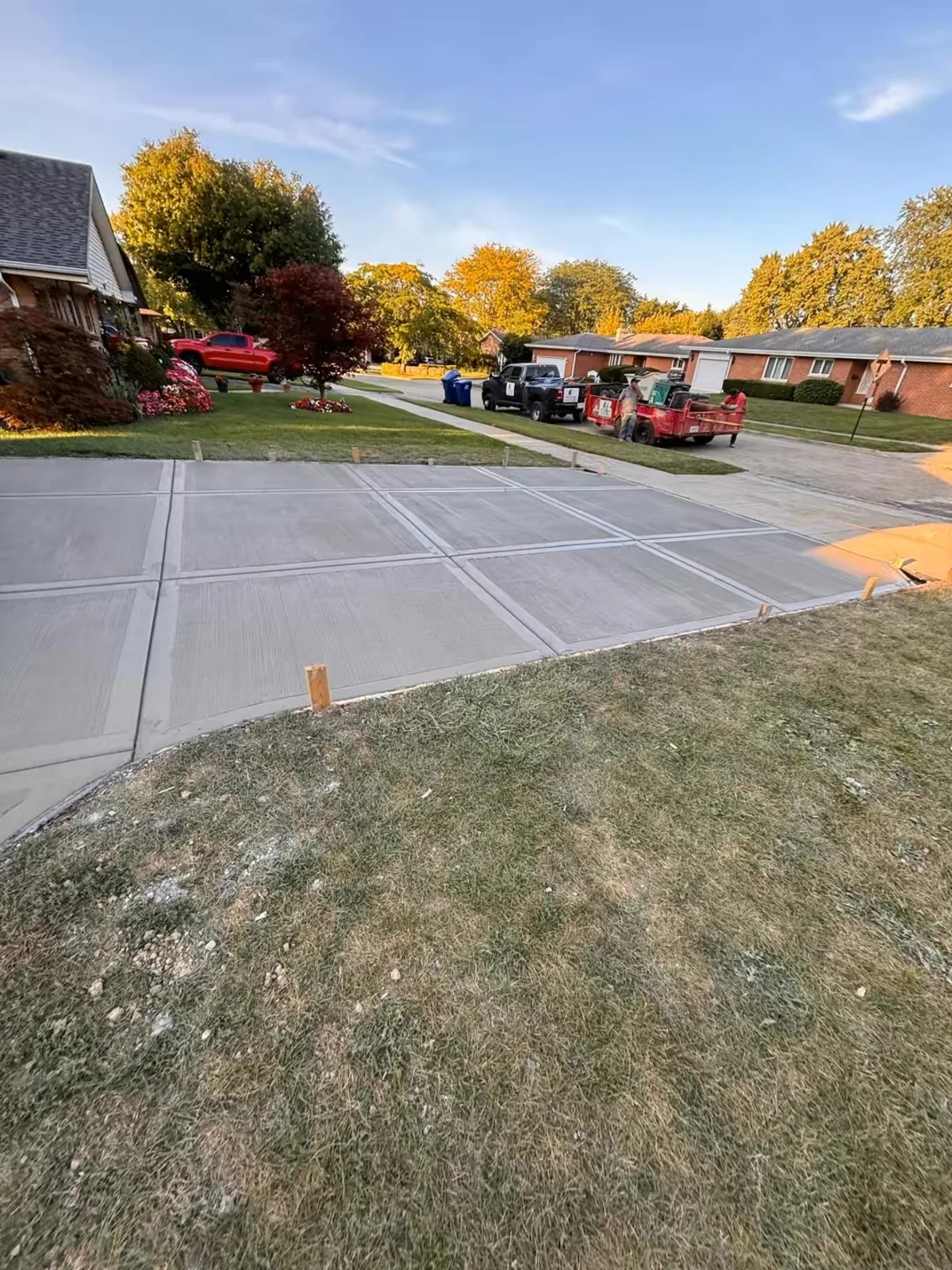
Properly spaced control joints guide where cracks form, keeping the surface clean
3. Freeze-Thaw Damage
This is especially relevant in Northern Illinois, where we experience 60–80+ freeze-thaw cycles per winter. Water enters the concrete through surface pores, small cracks, or poorly sealed joints. When temperatures drop, that water freezes and expands by about 9%, creating internal pressure that breaks apart the concrete from within. The surface symptom is usually scaling (flaking) or D-cracking (closely spaced cracks running parallel to joints).
Prevention: Air-entrained concrete is essential in Illinois. Tiny air bubbles (6–8% air content) are mixed into the concrete, giving the expanding water room to move without damaging the concrete matrix. Additionally, penetrating sealers applied every 2–3 years reduce water absorption significantly.
4. Overloading
Concrete has a weight-bearing limit based on its thickness, reinforcement, and sub-base. A standard 4-inch residential driveway supports regular passenger vehicles. But parking heavy equipment, dumpsters, or concrete trucks on a residential slab can exceed its capacity, causing cracking. This is common during home renovation projects when heavy trucks are driven over driveways not designed for that weight.
Prevention: Match concrete thickness and reinforcement to the expected load. Standard residential driveways should be 4 inches thick. If you park RVs, boats, or work trucks, 5–6 inches with rebar reinforcement is recommended. Commercial and heavy-use applications need 6–8 inches with engineered reinforcement.
5. Rapid Drying and Improper Curing
Concrete that dries too quickly — from hot weather, direct sun, or wind — develops surface cracks called crazing or map cracking. These fine, shallow cracks look like a spider web across the surface. While mostly cosmetic, they allow water to penetrate, which leads to bigger problems during freeze-thaw cycles. Proper curing means keeping the surface moist for at least 7 days using curing compound, wet burlap, or plastic sheeting.
When to Call a Professional
Hairline cracks under 1/16 inch are usually cosmetic and can be sealed with flexible concrete caulk. But contact a concrete repair professional if you notice cracks wider than ¼ inch, cracks that are growing or spreading, sections that have settled unevenly, or widespread surface scaling. Early repair prevents small problems from becoming expensive replacements.
Need help with concrete cracks? Call RCC Masonry & Concrete at (224) 441-5284 for a free assessment throughout McHenry and Lake County.