Discovering a crack in your foundation is unsettling. Your mind immediately goes to worst-case scenarios — is your house sinking? Is the wall going to collapse? Take a breath. While some foundation cracks are serious, many are completely normal and easily repairable. This guide will help you identify what type of crack you're dealing with, understand what's causing it, and know when to call a professional.
Types of Foundation Cracks (and What They Mean)
The direction, width, and pattern of a foundation crack tells a lot about its cause and severity. Here's how to read them:
Vertical Cracks
Vertical cracks (running straight up and down) are the most common type in poured concrete foundations. They're usually caused by concrete shrinkage during the initial curing process — the concrete loses moisture and contracts slightly, creating narrow vertical cracks. These are typically non-structural and appear within the first few years after construction. However, they should still be sealed because they provide a direct path for water to enter your basement. If a vertical crack is wider than ¼ inch or appears to be widening over time, it may indicate settlement and warrants professional evaluation.
Horizontal Cracks
Horizontal cracks are the most concerning type. They indicate lateral pressure from the soil outside pushing inward against the wall. In Northern Illinois, this pressure comes from two main sources: hydrostatic water pressure (wet, heavy soil) and frost pressure (frozen soil expanding against the wall). Horizontal cracks are a structural issue that requires professional repair — the wall is being pushed inward and may eventually bow or fail if the pressure isn't addressed. Don't ignore these.
Stair-Step Cracks
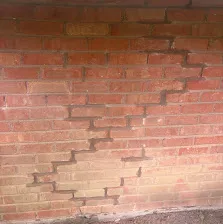
Stair-step cracks follow the mortar joints in block or brick foundations, creating a diagonal stepped pattern. They indicate differential settlement — one section of the foundation is settling faster or more than an adjacent section. This is often caused by changes in soil moisture (one side of the house is wetter than the other), poor soil compaction during construction, or erosion washing away support from underneath. The severity depends on the crack width: under ¼ inch is generally minor, but wider stair-step cracks indicate active settlement that needs professional attention.
Diagonal Cracks
Diagonal cracks (running at 30–75 degree angles) in poured concrete walls typically indicate settlement or soil pressure. Cracks that are wider at the top than the bottom suggest the foundation is settling on one end. Cracks wider at the bottom suggest frost heave or soil expansion lifting one section. The direction and width pattern help engineers determine the cause and appropriate repair.
Spider Web / Map Cracking
A pattern of small, interconnected cracks covering a large area (like a spider web or road map) is called pattern cracking or crazing. This is almost always a surface issue caused by rapid drying during the original concrete pour. While unsightly, map cracking is rarely structural. However, in severe cases, the surface can begin to flake and spall, which warrants a protective sealant application.
What Causes Foundation Cracks?
Understanding the cause is essential for choosing the right repair — and preventing the problem from recurring:
Concrete Shrinkage
All concrete shrinks slightly as it cures (loses moisture). This is completely normal and accounts for the majority of vertical hairline cracks in poured concrete foundations. Properly placed control joints (deliberate weakened lines in the wall) are designed to control where shrinkage cracks occur, but they don't prevent them entirely. Shrinkage cracks are typically static — they form and then don't widen further.
Soil Settlement and Expansion
Illinois soils — particularly the clay-heavy soils common in McHenry and Lake County — expand when wet and contract when dry. This seasonal volume change exerts tremendous pressure on foundation walls and can cause walls to shift, crack, and bow over time. Poor soil compaction during original construction makes this worse, as loosely compacted fill soil settles unevenly under the foundation's weight.
Water Pressure and Poor Drainage
When soil around your foundation stays saturated (from poor grading, clogged gutters, or inadequate drain tile), hydrostatic pressure builds against the basement walls. This pressure can reach several thousand pounds per square foot and is the primary cause of horizontal wall cracks and wall bowing. Properly managing water — through grading, gutters, downspout extensions, and drain tile systems — is the most important thing you can do to protect your foundation.
Freeze-Thaw Cycles
In Northern Illinois, we experience 50 to 80 freeze-thaw cycles per winter. Water in the soil freezes and expands, pushing against foundation walls (frost pressure). When it thaws, the soil relaxes. This repeated push-and-release cycle gradually weakens walls and widens existing cracks. Frost penetration depth in our area reaches 42 inches — which is why building codes require footings to be at least that deep. Shallow foundations are especially vulnerable.
Foundation Crack Repair Methods
Epoxy Injection
For non-structural cracks in poured concrete walls, epoxy injection fills the crack from front to back with a structural adhesive that bonds the concrete together and prevents water entry. Epoxy creates a seal that's actually stronger than the surrounding concrete. This is the standard repair for vertical shrinkage cracks. Cost: $300 to $600 per crack.
Polyurethane Injection
Similar to epoxy injection, but polyurethane foam expands as it cures, making it ideal for actively leaking cracks. The expanding foam fills voids and stops water flow. Polyurethane is more flexible than epoxy, which makes it better for cracks that may experience slight seasonal movement. Cost: $400 to $800 per crack.
Carbon Fiber Straps
For walls showing early signs of bowing (inward deflection up to 2 inches), carbon fiber straps bonded to the wall surface with structural epoxy prevent further movement. Carbon fiber has a higher tensile strength than steel, is only a few millimeters thick (so it doesn't reduce basement space), and can be finished over to be virtually invisible. Cost: $500 to $1,000 per strap, with straps typically placed every 4 feet.
Steel Beam Bracing
For walls with more significant bowing (over 2 inches), steel I-beams anchored to the floor and ceiling provide structural bracing that stops and can sometimes reverse wall movement. Steel beams are the traditional solution for bowing basement walls and are extremely effective. Cost: $4,000 to $8,000 for a full wall system.
Helical Pier Underpinning
When foundation settlement is the issue — the foundation is actually sinking — helical piers (steel screw-like shafts) are driven through the settling soil down to stable bearing strata, then used to lift and stabilize the foundation. This is the definitive solution for settlement problems and is used when cracks indicate the foundation is actively moving downward. Cost: $1,000 to $2,000 per pier, with most homes needing 6 to 10 piers.
Foundation Crack Repair Costs
| Repair Method | Typical Cost |
|---|---|
| Epoxy crack injection | $300 – $600 / crack |
| Polyurethane injection | $400 – $800 / crack |
| Carbon fiber straps | $500 – $1,000 / strap |
| Steel beam bracing | $4,000 – $8,000 / wall |
| Helical pier underpinning | $1,000 – $2,000 / pier |
| Exterior waterproofing + drainage | $5,000 – $15,000 |
When to Call a Professional
Call a foundation repair professional immediately if you notice:
- Any horizontal crack in a basement wall
- Stair-step cracks wider than ¼ inch in block or brick foundations
- Cracks that are visibly wider at one end than the other
- Walls that are bowing, leaning, or tilting inward
- Cracks that are growing or widening over time (mark them with tape and check monthly)
- Water actively leaking through cracks during rain
- Doors or windows sticking or not closing properly (can indicate foundation movement)
- Floors that are noticeably sloping or uneven
For small vertical hairline cracks in poured concrete that aren't leaking, monitoring is reasonable. But if you're unsure about any crack, getting a professional evaluation is always the safe choice. At RCC Masonry & Concrete, foundation inspections and estimates are free.
Preventing Foundation Problems
Most foundation problems are water problems. Managing moisture around your foundation is the single most effective prevention strategy:
- 1.Maintain proper grading — soil should slope away from the foundation at least 6 inches over the first 10 feet.
- 2.Keep gutters clean and direct downspouts at least 6 feet away from the foundation.
- 3.Ensure sump pump is working properly and has a battery backup.
- 4.Don't plant trees within 10 feet of the foundation — roots seek moisture and can undermine soil.
- 5.Fix plumbing leaks promptly — persistent water near the foundation saturates soil.
- 6.Maintain consistent soil moisture levels — extreme wet-dry cycles cause expansive clay soils to shift.
Get a Free Foundation Assessment
Foundation concerns shouldn't keep you up at night. At RCC Masonry & Concrete, we provide honest foundation assessments — we'll tell you if a crack is nothing to worry about, or if it needs attention. We serve homeowners throughout McHenry and Lake County, IL and provide detailed, written estimates at no cost.
Call (224) 441-5284 or request your free estimate online. Licensed, bonded, and insured — with a 5-year warranty on all foundation repair work.