Brick Veneer Installation & Repair
Professional brick veneer siding, thin brick cladding, and brick facade installation for homes and commercial buildings in McHenry & Lake County, IL. New construction, siding replacement, accent walls, and brick veneer repair — backed by our 5-year warranty.
What is Brick Veneer?
Brick veneer is a non-structural layer of brick applied to the exterior or interior of a building for aesthetic and weather-protection purposes. Unlike solid masonry walls, veneer is attached to a structural backing with ties and a drainage cavity, making it lighter and more cost-effective while delivering the classic brick appearance.
Brick Veneer — Quick Facts
- •Professional brick veneer installation for exteriors, wainscoting, interior accent walls, and fireplace surrounds — full-thickness and thin brick options.
- •Typical cost: Full exterior $18–$30/sq ft, interior accent wall $12–$20/sq ft, fireplace surround $1,500–$4,000.
- •Properly installed brick veneer lasts 50–100+ years with virtually zero maintenance.
- •All work backed by a 5-year workmanship warranty. Free on-site estimates.
- •Service area: McHenry County, Lake County, and surrounding Northern Illinois communities.
What is Brick Veneer Siding?
Brick veneer — also called brick cladding or brick siding — is a single wythe (layer) of real brick installed over a home's structural wood or steel frame. Unlike solid double-wythe brick construction, veneer is non-structural: your home's framing carries the load while the brick provides the exterior finish. This means you get the identical curb appeal, weather resistance, and durability of a full brick house at roughly half the material cost.
The key advantage of brick veneer over other siding materials is the drainage cavity — a 1-inch air gap between the brick and the sheathing that acts as both an insulation buffer and a moisture management system. In Northern Illinois, where wind-driven rain and freeze-thaw cycles are constant threats, this rain screen design is critical for preventing water damage behind the exterior wall.
At RCC Masonry & Concrete, we install both traditional full-thickness brick veneer (3⅝" deep, laid with mortar on a foundation ledge) and adhered thin-brick veneer (½" to ¾" slices bonded to cement board or metal lath), ensuring the right application for your structural needs, budget, and design goals.
New Construction
Full exterior wrapping for new builds.
Remodeling
Upgrading vinyl/wood siding to premium brick.
Full-Thickness vs. Thin Brick Veneer
We install both types of brick veneer. The right choice depends on your structure, budget, and application. Here's how they compare.
Full-Thickness Brick Veneer
Traditional brick siding — a full 3⅝"-deep brick wythe laid with mortar on a concrete foundation ledge or steel angle iron. This is the standard for new construction and full exterior brick cladding projects.
- Requires foundation ledge or lintel support
- 1-inch drainage cavity behind brick
- Best for: new builds, full exterior wraps, additions
- 50-100+ year lifespan with minimal maintenance
- Maximum curb appeal and resale value
Thin Brick Veneer (Adhered)
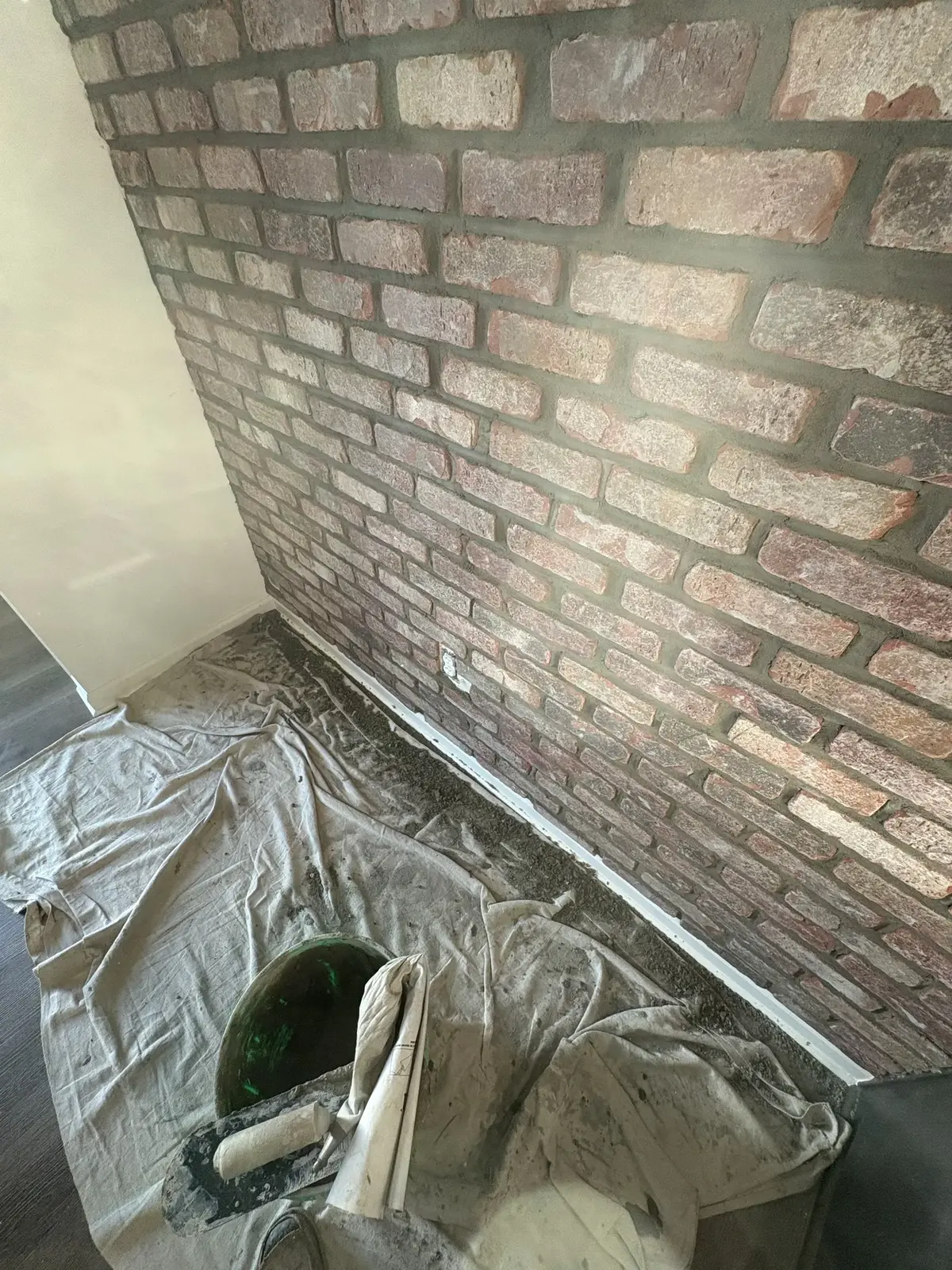
Real clay brick sliced or molded to ½"–¾" thickness, adhered to cement board, metal lath, or directly to concrete block with polymer-modified mortar. Ideal for remodeling and interior applications.
- No foundation ledge needed — lighter weight
- Can install over existing siding substrates
- Best for: accent walls, interior brick, remodels, fireplaces
- Real brick appearance and texture at lower cost
- Weighs ~⅓ of full-thickness — less structural demand
Where to Add Brick Veneer
Brick cladding isn't limited to full exteriors. It adds warmth, character, and lasting value to specific areas of your property — inside and out.
Full Exterior Brick Siding
Replace aging vinyl, wood, or fiber cement siding with a complete brick veneer wrap that instantly elevates curb appeal, home value, and weather resistance.
Brick Wainscoting (Half-Walls)
Add brick cladding to the lower third or half of your exterior walls — a popular choice in Crystal Lake, Huntley, and Barrington that protects against snow splash and grounds the house visually.
Interior Accent Walls & Backsplashes
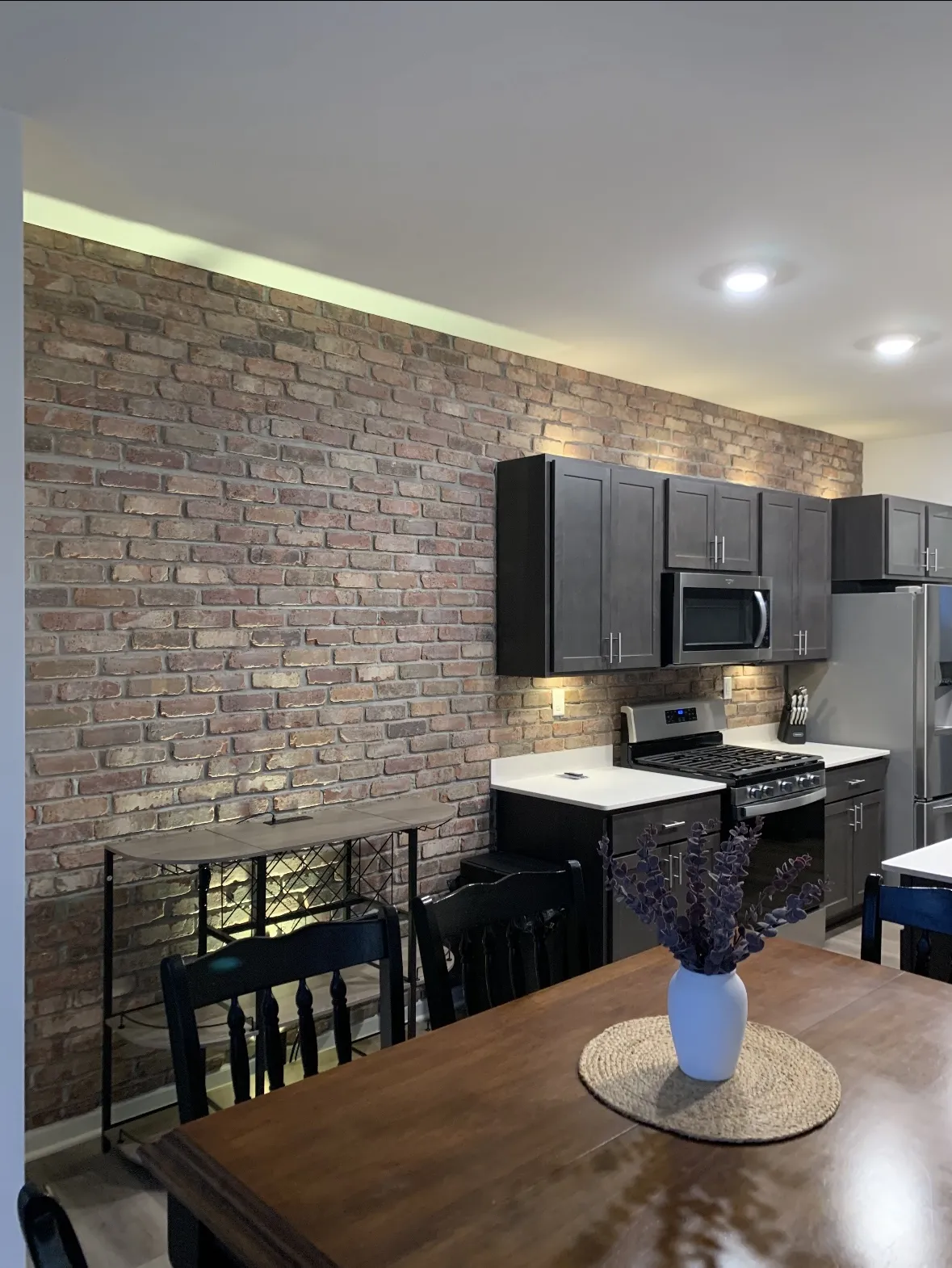
Thin brick veneer transforms living rooms, kitchens, basements, and commercial spaces with authentic exposed-brick texture. No structural modifications required.
Chimneys, Fireplaces & Columns
Wrap an existing block chimney, build a new brick fireplace surround, or add brick columns to your porch or entryway for a timeless architectural detail.
Brick Veneer vs. Other Siding Options
How does brick veneer siding compare to vinyl, fiber cement (Hardie board), wood, and stone? Here's an honest breakdown from a contractor who installs them all.
| Feature | Brick Veneer | Vinyl Siding | Fiber Cement | Natural Stone |
|---|---|---|---|---|
| Lifespan | 50–100+ years | 20–30 years | 30–50 years | 100+ years |
| Maintenance | Almost none | Periodic washing | Paint every 7–10 yrs | Minimal |
| Fire Resistance | Non-combustible | Melts/warps | Non-combustible | Non-combustible |
| Insulation Value | Excellent (thermal mass + air cavity) | Poor | Moderate | Good |
| Wind Resistance | 130+ mph | 100–110 mph | 130+ mph | 130+ mph |
| Cost per sq ft | $18–$30 | $3–$8 | $8–$14 | $30–$50+ |
| Resale ROI | Highest of all siding | Moderate | Good | Highest |
| Freeze-Thaw Durability | Excellent with air entrainment | Cracks in extreme cold | Good | Excellent |
Brick veneer costs more upfront than vinyl or fiber cement, but its 50–100+ year lifespan, zero painting costs, and superior resale value make it the lowest total cost of ownership over the life of your home.
The Superiority of Brick
Brick is one of the oldest and most trusted building materials in human history for a reason. Choosing brick veneer over vinyl or wood siding offers massive long-term benefits for Illinois homeowners.
Virtually Zero Maintenance
Brick never needs to be painted, stained, or treated. It naturally resists rot, termites, and woodpeckers.
Superior Insulation
The air cavity between the brick veneer and your home's framing provides excellent thermal mass, keeping you warmer in winter and cooler in summer.
Fire Resistance
Because brick is fired in a kiln at up to 2000°F, it is a non-combustible material that provides excellent fire protection.
Sound Dampening
The density of a brick veneer wall blocks out significantly more exterior noise (traffic, neighbors, lawnmowers) than standard siding.
The RCC Installation Difference
A brick veneer is only as good as the masonry holding it up. We never cut corners on the structural requirements:
- Proper Weep Holes: Ensuring moisture can escape from behind the wall.
- Heavy-Duty Wall Ties: Securing the brick firmly to the house frame.
- Premium Flashing: Preventing water from entering around windows and doors.
- Expert Mortar Mixing: Guaranteeing joint strength and uniform color.
Expert Insight: Why Brick Veneer Performance Depends on the Details Behind the Wall
In Northern Illinois, a brick veneer wall is not simply an aesthetic choice — it's a rain screen system that must manage moisture, temperature differentials, and structural movement simultaneously. The brick itself is the outermost layer; behind it sits a critical 1-inch air gap, a water-resistive barrier (WRB), and weep holes at the base that allow any moisture that penetrates the brick to drain out of the wall cavity. When any of these components fail or are omitted during construction, the consequences in our freeze-thaw climate are severe and expensive.
The most common brick veneer failure we repair in McHenry and Lake County is "moisture trapping." When a mason fills the drainage cavity with excess mortar (called "mortar droppings") during construction, or when weep holes are blocked or omitted, water that penetrates the veneer has no exit path. It saturates the sheathing, freezes during winter, and creates a cascading failure: rotted OSB sheathing, corroded brick ties, efflorescence on the brick face, and eventually bowing or bulging sections of wall. By the time the homeowner notices exterior symptoms, the hidden damage is often extensive.
Brick selection for new veneer in our climate requires understanding absorption rates. Bricks with high initial rate of absorption (IRA) — above 30 grams per minute — suck moisture out of the mortar too quickly, creating a weak bond at the mortar-brick interface. This weak bond allows water to penetrate the joint during driving rain, which then freezes and pops the brick face. We select bricks with an IRA between 5-25 g/min for Northern Illinois installations, and we pre-wet high-absorption bricks before laying to ensure the mortar achieves full bond strength. We also specify Type N mortar for veneer work — it provides the ideal balance of bond strength and flexibility that allows the wall to accommodate the thermal expansion our climate demands.
Brick ties — the metal connectors that anchor the veneer to the structural wall — are the hidden structural component that determines whether your veneer stays attached for 100 years or separates from the building within 20. In Lake County's freeze-thaw environment, we exclusively use stainless steel corrugated ties at 16" on center vertically and every stud horizontally, with additional ties around all window and door openings. Galvanized ties corrode in as few as 15-20 years when exposed to moisture in the wall cavity, eventually losing their grip and allowing the veneer to pull away from the structure — a safety hazard that requires complete wall reconstruction to fix.
Can You Add Brick Veneer to an Existing House?
Yes — and it's one of the most common requests we receive in McHenry and Lake County. Adding brick veneer siding to an existing home is absolutely possible, but it requires careful structural evaluation and proper engineering. The main consideration is whether your existing foundation can support the additional weight of a full-thickness brick wythe, which adds roughly 40 pounds per square foot to the wall.
For homes with an existing concrete foundation that extends beyond the framing (a "ledge"), full-thickness brick veneer can often be installed directly. Many homes in Huntley, Crystal Lake, Algonquin, and Lake in the Hills were built with this ledge specifically to accommodate future brick cladding. If no foundation ledge exists, we install a galvanized steel angle iron (lintel) anchored to the foundation wall with concrete wedge anchors. This steel support transfers the brick's weight directly to the foundation without modifying the footing.
For homes where structural loading is a concern — older homes, second-story applications, or homes on pier foundations — adhered thin-brick veneer is the ideal solution. Thin brick weighs approximately 12-15 pounds per square foot (compared to 40+ for full brick), can be installed over cement board attached to existing studs, and requires no foundation modification. From 10 feet away, thin brick is visually indistinguishable from full-thickness — the color, texture, and mortar joints are identical because thin bricks are literally sliced from full-size bricks.
The conversion process from vinyl or wood siding to brick typically takes 2-4 weeks for an average-sized home. We remove the existing siding, inspect the sheathing for rot or damage (repairing as needed), install a water-resistive barrier, and then build the brick veneer with a proper drainage plane behind it. The result is a dramatic transformation — homes in Grayslake, Mundelein, and Libertyville that have converted from vinyl to brick typically see an immediate 5-8% increase in appraised value, plus significantly lower long-term maintenance costs.
Commercial Brick Veneer Installation
Brick veneer isn't just for residential homes. We install brick cladding and brick facades on commercial buildings, retail storefronts, restaurants, office buildings, and multi-family properties throughout McHenry and Lake County. Commercial brick veneer projects require different engineering than residential — larger wall areas mean more thermal expansion stress, higher wind loads require closer tie spacing, and commercial building codes (IBC) have stricter requirements for fire ratings, cavity barriers, and flashing details.
For commercial new construction, we work directly with architects and general contractors to ensure the brick veneer specification meets both the design intent and structural requirements. We're experienced with running bond, stacked bond, Flemish bond, and herringbone patterns — each creating a distinct architectural character. We also install brick veneer over steel stud framing (common in commercial construction), which requires adjustable brick ties that accommodate the larger deflection tolerances of steel versus wood framing.
For commercial renovations and tenant improvements, thin brick veneer panels are an excellent solution. They can be installed over existing block, concrete, or drywall surfaces with minimal disruption to business operations. Restaurants, breweries, and retail spaces across Lake Zurich, Vernon Hills, and Wauconda use interior thin brick to create an authentic industrial or loft aesthetic that attracts customers.
Areas We Serve
Professional brick veneer services across McHenry & Lake County, IL.
Ready to Build with Brick?
Contact us today to discuss your project. We'll help you select the perfect brick style, explain the process, and provide a detailed estimate.
Materials We Use
We use only premium brick products and installation materials to ensure every veneer project is structurally sound and visually stunning.
Clay Brick
Traditional kiln-fired clay brick available in hundreds of colors, textures, and sizes. Extremely durable and weather-resistant for Illinois conditions.
Thin Brick Veneer
Sliced or molded brick panels roughly 1/2" thick that adhere directly to walls. Weighs about one-third of full brick, ideal for interior accent walls and remodels.
Adhesive Mortar
High-bond, polymer-modified mortar specifically designed for securing thin brick veneer to various substrates including drywall, concrete, and cement board.
Weep Hole Systems
Engineered drainage inserts installed at the base of veneer walls to allow trapped moisture to escape, preventing water damage behind the brick.
Galvanized Flashing
Corrosion-resistant metal flashing installed above windows, doors, and foundation lines to direct water away from the wall cavity.
Heavy-Duty Wall Ties
Corrugated or adjustable galvanized steel ties that mechanically anchor the brick veneer to the home's structural framing at code-required intervals.
Common Brick Veneer Issues We Fix
Even durable brick veneer can develop problems over time, especially in the harsh Northern Illinois climate. Here are the issues we see and repair most often.
Cracking & Shifting
Foundation settling, thermal expansion, or improper installation can cause cracks in the brick veneer or visible shifts in the wall plane.
Efflorescence
White, powdery mineral deposits that appear on brick surfaces when moisture migrates through the wall and evaporates, leaving salt crystals behind.
Mortar Joint Deterioration
Freeze-thaw cycles and weathering cause mortar between bricks to crumble, creating gaps that allow water infiltration and further damage.
Water Damage & Moisture Intrusion
Failed flashing, missing weep holes, or cracked mortar can allow water behind the veneer, leading to mold, rot, and structural decay.
Brick Spalling
When trapped moisture freezes inside the brick face, it causes the outer layer to flake or pop off — especially common on north-facing walls in Illinois.
Lintel Failure Above Openings
Rusted or sagging steel lintels above windows and doors cause the brick above to crack, separate, or bow outward, requiring immediate repair.
Cost Expectations
Transparent pricing for brick veneer projects in the McHenry and Lake County area. Every project receives a free, detailed estimate.
Full Brick Veneer Exterior
Complete exterior brick wrapping for new construction or siding replacement.
Brick Wainscoting (Half-Wall)
Brick veneer applied to the lower portion of exterior walls.
Interior Thin Brick Accent Wall
Thin brick veneer installed on interior walls for modern or rustic aesthetics.
Chimney Brick Wrapping
Applying brick veneer to an existing block or framed chimney chase.
Brick Veneer Repair
Fixing cracked, spalling, or water-damaged sections of existing brick veneer.
Fireplace Surround
Custom brick facing for indoor or outdoor fireplace surrounds.
Prices are estimates and vary based on project scope, materials, and site conditions. Contact us for a free, no-obligation quote.
Frequently Asked Questions
Everything you need to know about brick veneer installation.
Still Have Questions?
Contact us directly — we're happy to answer any concerns about brick veneer installation.
Call (224) 441-5284