Structural Foundation Repair
A compromised foundation threatens your entire home. We don't believe in "one-size-fits-all" fixes. We diagnose the specific structural failure and apply targeted, engineered solutions to permanently stabilize your property.
What is Foundation Repair?
Foundation repair is the structural stabilization of a building's base using methods like crack injection, carbon fiber reinforcement, steel I-beam bracing, or helical pier underpinning. In Illinois, expansive clay soils and hydrostatic pressure cause bowing walls, horizontal cracks, and settlement that worsen rapidly without professional intervention.
Foundation Repair — Quick Facts
- •Structural foundation repair: crack injection, carbon fiber/steel reinforcement for bowing walls, underpinning, waterproofing, and drain tile systems.
- •Typical cost: Crack injection $500–$1,500, wall reinforcement $5,000–$15,000+, waterproofing $4,000–$12,000.
- •Most residential foundation repairs completed in 2–5 days.
- •All work backed by a 5-year workmanship warranty. Free on-site estimates.
- •Service area: McHenry County, Lake County, and surrounding Northern Illinois communities.
Why Foundations Fail in Illinois
Northern Illinois soil is heavily clay-based. When it rains, the clay absorbs water and expands, putting immense "hydrostatic pressure" on your foundation walls. When it dries, the soil shrinks, removing support and causing the foundation to settle.
Over decades, this constant expanding and contracting causes concrete to crack, block walls to bow inward, and footings to sink. Identifying exactly how your foundation is failing is the first step to choosing the right repair application.
Signs of Structural Movement:
- Horizontal or stair-step cracks in basement walls
- Doors and windows that stick or won't close properly
- Walls leaning or bowing inward
- Water actively leaking through floor or wall cracks
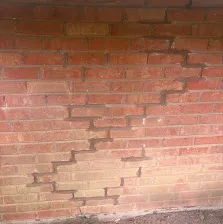
Hydrostatic pressure causing structural wall cracking
Tailored Repair Applications
We diagnose the exact cause of your foundation issue and apply the specific structural engineering method required to fix it permanently. Here is exactly how we solve different failures.
1. Epoxy & Polyurethane Injection
Best For: Minor, non-moving cracks and water infiltration in poured concrete walls.
Our Process: We clean the crack thoroughly and install injection ports along its length. We then inject structural epoxy (for strength) or expanding polyurethane (to stop active water leaks) deep into the wall under pressure, completely filling the void from the inside out to restore structural integrity.
2. Foundation Tuckpointing
Best For: Older block or brick foundations with deteriorating mortar joints.
Our Process: Deteriorated mortar severely weakens block walls. We use specialized dustless grinders to remove the failing mortar to a uniform depth. We then inject high-strength structural mortar back into the joints, tooling it to create a waterproof, load-bearing seal that prevents further deterioration.
3. Wall Reinforcement Systems
Best For: Walls that are bowing, leaning, or bulging inward from soil pressure.
Our Process: Depending on the severity of the bow, we install structural supports to halt movement. This includes installing rigid steel I-beams, applying aerospace-grade carbon fiber straps directly to the wall, or installing wall anchors driven deep into the exterior yard to pull the wall back into alignment.
4. Underpinning & Piering
Best For: Foundations that are actively sinking or settling due to weak soil beneath the footings.
Our Process: We excavate down to the foundation footing. We then hydraulically drive heavy-duty steel push piers or helical piers deep into the earth until they hit solid bedrock or load-bearing strata. The weight of your home is then transferred from the weak soil onto these steel piers, permanently lifting and stabilizing the structure.
5. Drainage Improvements
Best For: Stopping hydrostatic pressure and preventing future foundation movement.
Our Process: Water is the enemy of foundations. We relieve pressure by installing interior or exterior French drain tile systems, installing high-capacity sump pumps, improving exterior soil grading to pitch water away from the home, and extending downspouts away from the foundation zone.
6. Exterior Waterproofing
Best For: Preventing ground water from penetrating porous block or concrete walls.
Our Process: We excavate the exterior wall down to the footing. We repair any exterior cracks, apply a thick, rubberized elastomeric membrane to the wall, and install a dimpled drainage board. This creates an impenetrable barrier that forces water down to the drain tile instead of into your basement.
7. Partial/Full Rebuilds
Best For: Severely deteriorated block or stone foundations that are beyond saving.
Our Process: When a wall has failed completely, we install heavy-duty shoring jacks to support the weight of the house above it. We then safely demolish the failed foundation section and rebuild it entirely using modern, reinforced concrete block or poured concrete, tying it seamlessly into the existing structure.
8. Concrete Resurfacing
Best For: Foundations with surface flaking (spalling) but sound underlying structure.
Our Process: We chip away all loose, flaking concrete until we reach solid material. We apply a bonding agent, then trowel on a specialized, high-strength structural repair mortar. This restores the smooth, uniform look of the wall and seals the aggregate from further freeze-thaw damage.
Expert Insight: Why Lake County Foundations Crack — The Science Behind the Damage
McHenry and Lake County sit on glacial-deposit clay soils that behave like a sponge — absorbing water and swelling in spring, then drying out and shrinking dramatically during summer droughts. This seasonal volume change creates what structural engineers call "differential settlement": different sections of your foundation move at different rates, generating concentrated stress that exceeds the concrete's tensile strength (typically only 400-500 PSI) and produces cracks.
The frost line in Northern Illinois extends to 42 inches below grade — meaning your foundation footings must extend at least that deep to sit below the zone where soil freezes and expands. Homes built before modern code enforcement (pre-1970s) often have footings at only 30-36 inches, leaving them vulnerable to frost heave. When soil beneath a footing freezes and lifts one section of your wall while the adjacent section stays put, the resulting shear force cracks the wall along the weakest path — usually through window openings or at cold joints where the pour was interrupted.
Horizontal cracks in block or poured walls tell a different story. These are caused by hydrostatic pressure — the literal weight of water-saturated clay soil pressing inward against your foundation wall. In Lake County, spring snowmelt can saturate soil to depths of 4-6 feet, generating lateral pressures exceeding 40 pounds per square foot. Block walls are especially vulnerable because the mortar joints between blocks are inherently weaker than the blocks themselves. When hydrostatic pressure exceeds the mortar's bond strength, the wall bows inward along the horizontal joint — a failure that, left unaddressed, will eventually cause the wall to collapse.
RCC approaches each foundation differently based on the failure mechanism. For vertical settlement cracks under ¼ inch, epoxy injection bonds the crack at full structural strength while creating a waterproof seal. For horizontal bowing, we install carbon fiber reinforcement straps — rated at 14,000 PSI tensile strength — that permanently prevent further inward movement. For severe cases where the wall has moved more than 2 inches, we install steel I-beam braces anchored to the floor slab and floor joists. Every repair also addresses the root cause: exterior drainage, downspout extensions, and grading corrections that redirect water away from the foundation wall.
Foundation Repair Methods: When to Use Each in Northern Illinois
Lake County's expansive clay soils create foundation problems that require specific repair methods. Using the wrong approach wastes money and can make the problem worse. Here's how we match repair method to damage type:
| Repair Method | Problem It Solves | Typical Cost | Illinois-Specific Notes |
|---|---|---|---|
| Epoxy Crack Injection | Non-structural shrinkage cracks (hairline to ¼") | $500–$1,500 | Rigid structural bond; only appropriate when foundation is stable and crack is not actively moving |
| Polyurethane Injection | Active water leaks, expanding cracks | $600–$1,800 | Flexible seal accommodates seasonal clay soil movement; better than epoxy for Lake County's shifting soils |
| Carbon Fiber Straps | Bowing walls (up to 2" inward deflection) | $800–$1,200/strap | 10x stronger than steel per weight; prevents further inward movement from hydrostatic pressure and frost heave |
| Steel I-Beam Braces | Severe bowing (over 2" deflection), actively moving walls | $1,000–$1,500/beam | Can be tightened over time to gradually straighten wall; anchored to footing and floor joist for full structural support |
| Helical Piers | Foundation settling, sinking corners | $1,500–$3,000/pier | Screwed through clay into stable bearing soil (typically 15-25 ft deep in McHenry County); lifts foundation back to level |
| Exterior Waterproofing | Chronic water infiltration, failed drain tile | $8,000–$15,000+ | Excavation to footing, new drainage membrane + drain tile; essential for homes on high water table areas near Fox River and Chain O'Lakes |
Why We Start Every Project with Crack Monitoring
Before recommending a repair method, we install crack monitors on active cracks for 2-4 weeks to determine if the foundation is still moving or has stabilized. A crack that hasn't moved in years needs a different solution than one that's actively widening. This diagnostic step prevents overbuilding (expensive overkill) and underbuilding (repair that fails within a year). It's standard practice for structural engineers — and should be standard for any foundation contractor working in Lake County's clay soils.
Areas We Serve
Professional foundation repair services across McHenry & Lake County, IL.
Don't Let Foundation Issues Compound.
Foundation problems never fix themselves—they only get worse and more expensive over time. Contact our structural experts today for a comprehensive evaluation.
Materials We Use
We use engineered materials designed to permanently stabilize and protect your foundation.
Hydraulic Cement
Fast-setting, water-resistant cement that expands as it cures to create a watertight seal in active leaks and cracks.
Epoxy Injection Resin
Structural-grade epoxy injected under pressure to fill and bond concrete cracks, restoring full load-bearing capacity.
Carbon Fiber Straps
Aerospace-grade carbon fiber reinforcement bonded to bowing walls to halt inward movement and provide permanent stabilization.
Steel Push Piers
Heavy-duty galvanized steel piers driven to bedrock to permanently support and lift settling foundations.
Polyurethane Foam
Expanding polyurethane injection that fills voids and stops active water leaks through foundation walls and floor joints.
Waterproof Membranes
Rubberized elastomeric coatings applied to exterior foundation walls to create an impenetrable moisture barrier.
Common Foundation Issues We Fix
These are the most frequent foundation problems we encounter in Northern Illinois homes.
Horizontal Cracks
Cracks running horizontally along basement walls indicate extreme hydrostatic soil pressure pushing against the foundation — a serious structural failure.
Stair-Step Cracks
Diagonal cracks following mortar joints in block walls, typically caused by differential foundation settlement or soil movement.
Bowing & Leaning Walls
Foundation walls bowing inward from clay soil expansion pressure — common in Illinois homes built on expansive clay soils.
Water Seepage
Active water leaking through floor-wall joints, cracks, or porous block walls during heavy rain or snowmelt periods.
Foundation Settlement
The foundation sinking unevenly due to weak or eroding soil beneath the footings, causing doors to stick and floors to slope.
Deteriorating Block Walls
Concrete block foundations with crumbling mortar joints, spalling faces, or structural failure from decades of moisture exposure.
Cost Expectations
Transparent pricing for foundation repair in McHenry and Lake County.
Crack Injection (Epoxy/Polyurethane)
Per crack — sealing non-moving cracks and stopping active water leaks
Wall Tuckpointing & Mortar Repair
Repointing deteriorated mortar joints in block or brick foundation walls
Carbon Fiber Wall Reinforcement
Per wall — stabilizing bowing walls with carbon fiber strap systems
Steel Pier Underpinning
Driving steel piers to bedrock to lift and stabilize settling foundations
Exterior Waterproofing
Excavation, membrane application, and drainage installation per wall
Complete Foundation Rebuild
Partial or full wall demolition and reconstruction with reinforced concrete
Prices are estimates and vary based on project scope, materials, and site conditions. Contact us for a free, no-obligation quote.
Frequently Asked Questions
Everything you need to know about foundation repair.
Still Have Questions?
Contact us directly — we're happy to answer any concerns about foundation repair.
Call (224) 441-5284