Retaining Walls in Northern Illinois
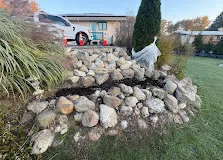
From McHenry County to Lake County and the northern collar suburbs, RCC builds engineered retaining walls that solve erosion and slope problems permanently — block, poured concrete, natural stone, and boulder walls, all built with the drainage systems most contractors skip.
What is Retaining Walls in Northern Illinois?
A retaining wall holds back earth, manages water flow, and creates usable space on sloped properties. In Northern Illinois — where heavy clay soils and 80+ freeze-thaw cycles per winter put extreme lateral pressure on retaining systems — drainage and reinforcement are what separate a 30-year wall from one that leans and cracks in 5.
Retaining Walls in Northern Illinois — Quick Facts
- •All wall types: segmental block (Versa-Lok, Allan Block, Belgard), poured concrete, natural stone, boulder, and timber replacement.
- •Every wall includes proper drainage: perforated drain tile, filter fabric, and clean #57 stone backfill — never just dirt against the back of the wall.
- •Geogrid reinforcement on every wall over 4 ft tall; engineered design and permit support for taller commercial walls.
- •Typical cost: $30–$55 per sq ft of wall face for block, $50–$120 for natural stone, $35–$80 per linear ft for boulder.
- •Serving all of Northern Illinois — McHenry County, Lake County, Kane County, and surrounding communities.
Why retaining walls in Northern Illinois fail — and what we do differently
Northern Illinois retaining walls fail for one reason 90% of the time: hydrostatic water pressure behind the wall. When clay soil saturates after spring thaw or heavy fall rain, the water has nowhere to go — and a 6-foot wall can have 500+ pounds per square foot of lateral pressure pushing on it. Without proper drainage, that pressure tilts blocks forward, cracks concrete walls, and eventually causes total collapse. We see this on almost every "failing wall" call we get in McHenry and Lake County.
The fix isn't more wall — it's more drainage. Every wall we build includes a 4" perforated drain tile at the base, wrapped in non-woven geotextile filter fabric, then surrounded by a full 12" zone of clean #57 washed stone. The drain tile daylights to a positive outfall (or ties into existing storm drainage). This system relieves water pressure before it can build against the wall — and it's the single biggest reason our walls hold straight and tight for 30+ years.
Northern Illinois also requires specific reinforcement strategies because of clay soil expansion. For segmental block walls over 4 feet, we install geogrid layers every 2–3 courses, extending 6–8 feet back into the retained soil mass. The geogrid locks the soil and the wall together so they move as one engineered unit — preventing the slow, season-by-season "creep" that destroys non-reinforced walls. For taller walls, walls supporting driveways, or commercial earth retention, we work with structural engineers to produce sealed designs that meet local code and permit requirements.
Finally, freeze-thaw protection. Walls built with budget timbers or low-grade block fail catastrophically here — railroad ties rot in 8–12 years, and non-air-entrained block cracks face-out within a few winters. We build with proper architectural-grade segmental block, dimensional natural stone, or 4,000 PSI air-entrained poured concrete. Every cap is sealed with an exterior-grade adhesive rated for our temperature swings, and every base course is set on a compacted aggregate leveling pad that won't heave with the soil.
The RCC Process
Every retaining wall construction project in Northern Illinois follows the same disciplined process — engineered for our climate, soils, and code requirements.
Site & soil evaluation
We walk the site, identify slope direction, water flow patterns, soil type, and load conditions. Walls over 4 ft get engineered designs.
Excavation & drainage
We dig the base trench to proper depth, install perforated drain tile in #57 stone, wrap with filter fabric, and prep a compacted aggregate leveling pad.
Wall construction
Block, stone, concrete, or boulder placement with proper setback, mortar or adhesive, and geogrid reinforcement every 2–3 courses on taller walls.
Backfill, cap & restore
Drainage stone backfill compacted in lifts behind the wall, sealed cap course, surface grade restored to direct water away from the wall and your home.
The Northern Illinois retaining wall crew
RCC Masonry & Concrete is based in Lakemoor, IL and builds retaining walls across the entire Northern Illinois region. We're certified Allan Block and Versa-Lok installers, we work directly with structural engineers on commercial walls, and we never cut the drainage corners that cause walls to fail. Every wall carries a 5-year workmanship warranty.
- Licensed, bonded & insured masonry and concrete contractor
- 5-year workmanship warranty on every project
- Free on-site estimates — no obligation, no high-pressure sales
- Local crew based in Lakemoor, IL — not a national franchise
Communities We Serve in Northern Illinois
Don't see your town? We service the entire Northern Illinois area — call us to confirm coverage.
Build a wall that lasts a lifetime.
Erosion and soil movement only get worse with every Northern Illinois freeze-thaw cycle. Get a professionally engineered retaining wall designed for our clay soils and our winters.
Frequently Asked Questions
Retaining Wall Construction questions from homeowners in Northern Illinois.