Professional Tuckpointing
Don't let crumbling mortar lead to expensive structural damage. We provide expert color-matched tuckpointing services across McHenry and Lake County to restore your masonry to its original strength and beauty.
What is Tuckpointing?
Tuckpointing is the process of removing deteriorated mortar from brick joints and replacing it with fresh, color-matched mortar. In Northern Illinois, freeze-thaw cycles accelerate mortar decay, making professional tuckpointing essential to prevent water infiltration, structural cracking, and costly brick replacement.
Tuckpointing — Quick Facts
- •Tuckpointing is the process of grinding out deteriorated mortar joints and filling them with fresh, color-matched mortar to restore structural integrity and weatherproofing.
- •Typical cost: $8–$15 per square foot for standard residential work; chimney tuckpointing runs $800–$2,500.
- •Properly executed tuckpointing lasts 25–30 years in Northern Illinois.
- •All work backed by a 5-year workmanship warranty. Free on-site estimates.
- •Service area: McHenry County, Lake County, and surrounding Northern Illinois communities.
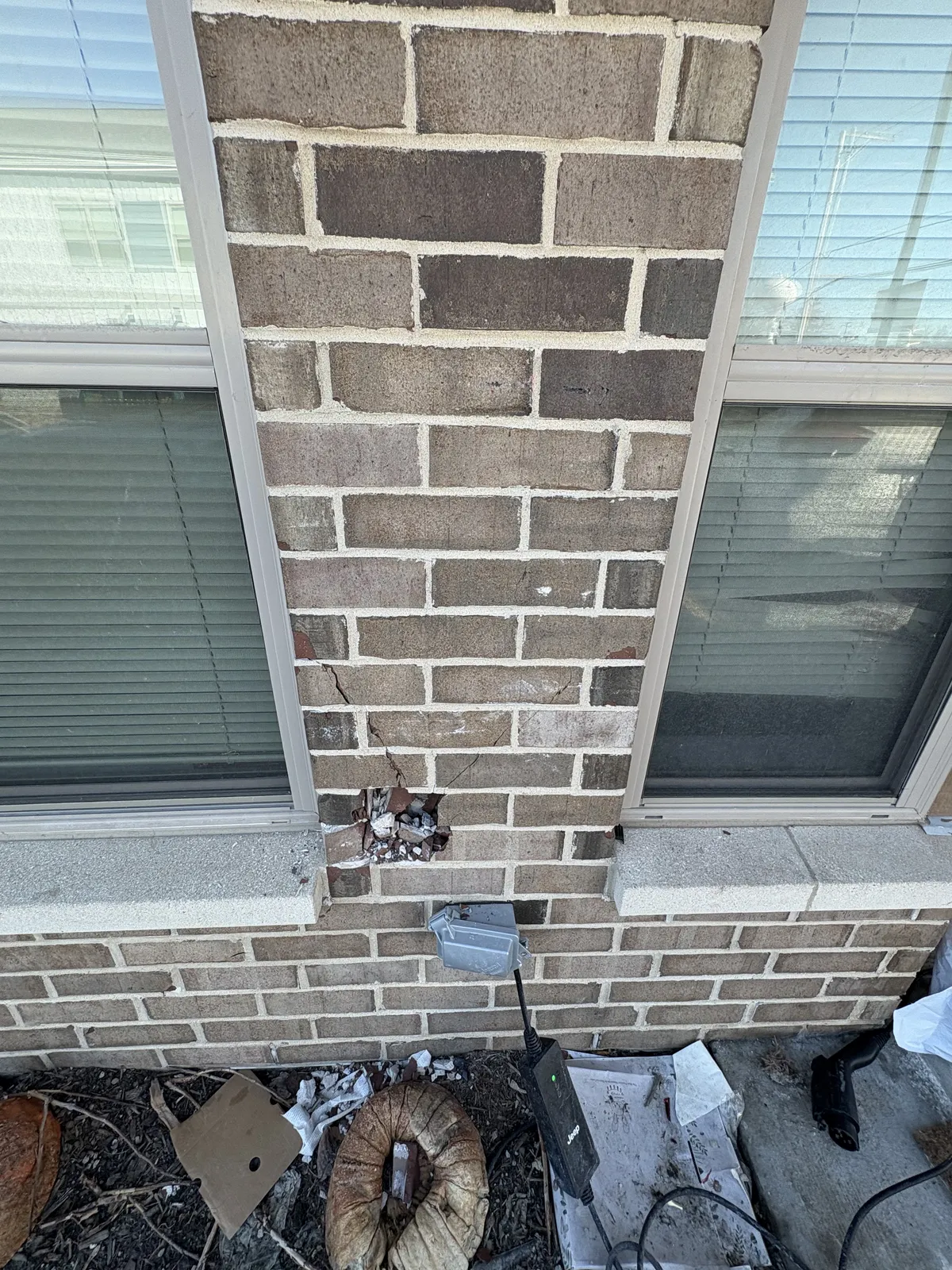
Severely deteriorated mortar joints allowing water penetration
The Hidden Dangers of Failing Mortar
Brick and stone are incredibly durable, but the mortar holding them together is designed to be the sacrificial element. Over time, weathering, freeze-thaw cycles, and building settlement cause mortar joints to crack, crumble, and wash away.
When mortar fails, water easily enters your wall system. In freezing temperatures, this trapped water expands, physically breaking apart the faces of your bricks (spalling) and potentially destroying the structural integrity of your wall.
Signs You Need Tuckpointing:
- Visible gaps, holes, or missing chunks in your mortar joints
- A white powdery substance (efflorescence) appearing on the brick
- Water leaks or moisture spots on your interior plaster or drywall
- Bricks that feel loose or appear to be bulging outward
- Mortar that easily flakes away when you rub it with a key or coin
Our Tuckpointing Process
We don't just smear new mortar over the old problems. RCC follows a rigorous, professional process to ensure a permanent, structurally sound repair that looks seamless.
1. Precise Grinding
We use specialized diamond-blade grinders equipped with dust vacuums to carefully remove the deteriorated mortar to a uniform depth, without damaging the surrounding brick faces.
2. Custom Mortar Matching
We analyze your existing mortar to create a custom mix. We match not just the color, but the exact strength and aggregate texture so the repair blends in flawlessly.
3. Professional Tooling
Our master masons inject the new mortar and 'tool' the joints to match the original profile (concave, V-joint, etc.), creating a weather-tight seal that sheds water efficiently.
Expert Insight: Why Lake County's Climate Demands Specific Mortar Types
Northern Illinois experiences one of the most aggressive freeze-thaw environments in the country. Between November and March, the McHenry and Lake County region averages over 80 freeze-thaw cycles per winter — meaning temperatures cross the 32°F threshold roughly once per day. Each cycle allows moisture inside your mortar joints to freeze, expand by approximately 9%, and physically fracture the mortar from within. Over a single season, this can degrade a mortar joint by ⅛" or more.
This is why mortar selection is critical — and why so many tuckpointing jobs done by general contractors fail within a few years. Modern Portland-based Type S mortar (the most common off-the-shelf mix) is extremely hard and rigid. On homes built before 1920 that use soft, lime-fired brick, Type S mortar is actually too hard. It doesn't flex with the building's natural thermal movement, and instead transfers stress directly into the brick faces, causing them to crack and spall. The result? Your tuckpointing job makes the damage worse, not better.
At RCC, we test your existing mortar before mixing a single batch. For older homes in Crystal Lake, Woodstock, and Barrington, we often specify Type O or a custom lime-rich hybrid mortar that's softer than the surrounding brick. This allows the mortar to absorb movement and act as the sacrificial element it's designed to be — protecting your irreplaceable bricks for decades. For newer construction with modern engineered brick, we use Type N or Type S with precise air-entrainment ratios (5-7%) that create microscopic air bubbles inside the mortar, giving frozen water room to expand without fracturing the joint.
We also pay close attention to joint profile. A tooled concave joint sheds water far more effectively than a flat or raked joint, reducing the amount of moisture that penetrates the wall system in the first place. In Lake County's climate, this single detail can extend the life of your tuckpointing by 10-15 years compared to an improper joint profile. These are the details that separate a professional tuckpointing job from one that looks good for a season and then fails.
Mortar Type Selection Guide for Northern Illinois
Choosing the wrong mortar type is the #1 cause of premature tuckpointing failure in McHenry and Lake County. Mortar must be softer than the brick it surrounds — otherwise freeze-thaw stress cracks the brick instead of the replaceable mortar joint. Here's how we select mortar for every project:
| Mortar Type | Compressive Strength | When We Use It | Common Applications |
|---|---|---|---|
| Type O | 350 PSI | Pre-1920s soft clay brick, historic restoration | Lime-rich mortar for antique Chicago common brick; allows moisture to escape through joints rather than through brick face |
| Type K | 75 PSI | Pre-1900 lime mortar buildings, landmark structures | Pure lime putty mortar for the softest historic brick; used on buildings originally built with no Portland cement |
| Type N | 750 PSI | Post-1950 residential, above-grade walls, chimneys | The standard for most residential tuckpointing in Lake County; best balance of bond strength, flexibility, and freeze-thaw durability |
| Type S | 1,800 PSI | Below-grade, retaining walls, foundations, high-wind areas | Higher Portland content for structural applications; too hard for most above-grade residential brick — causes spalling on softer brick |
| Type M | 2,500 PSI | Foundation walls, load-bearing structures, below-grade | Maximum compressive strength for heavy structural loads; poor bond strength makes it wrong for above-grade walls and chimneys |
Common Mistake We Fix
Many contractors use Type S mortar on everything because it's "stronger." On above-grade residential brick walls, Type S is actually too strong — it doesn't flex with thermal movement. When the wall expands and contracts through our 120°F annual temperature swing, the rigid mortar transfers stress into the brick, causing face spalling. We've repaired hundreds of walls in Crystal Lake, Woodstock, and Barrington where Type S mortar destroyed the brick it was supposed to protect.
Our Illinois-Specific Spec
For most residential tuckpointing in McHenry and Lake County, we specify Type N mortar with 6% air entrainment. The air entrainment creates microscopic relief chambers inside the mortar that absorb the expansion pressure when water freezes — extending mortar joint life by 30-50% compared to non-air-entrained mix. We also add integral color pigment to match your existing mortar tone, so the repair is invisible.
Areas We Serve
Professional tuckpointing services across McHenry & Lake County, IL.
Save Your Brickwork Today.
Waiting to fix crumbling mortar will eventually lead to a total tear-down and rebuild. Protect your property value with our expert tuckpointing services.
Materials We Use
We select professional-grade mortar products and pigments to ensure every tuckpointing repair is durable and visually seamless.
Type N Mortar
A versatile, medium-strength mortar ideal for above-grade exterior walls and chimneys. Excellent workability and weather resistance for Northern Illinois conditions.
Type S Mortar
A high-strength mortar used for below-grade applications, retaining walls, and areas subject to heavy wind loads or lateral pressure.
Lime Putty Mortar
A traditional, softer mortar essential for historic brick homes (pre-1920s). Prevents spalling by allowing old, soft brick to flex naturally.
Custom-Matched Pigments
We blend iron oxide and mineral-based pigments to precisely match the color of your existing mortar joints, ensuring invisible repairs.
Grout Bags & Pointing Tools
Professional pointing bags and specialized joint tooling equipment allow us to fill and shape mortar joints with precision and consistency.
Diamond-Blade Grinders
We use precision diamond-tipped grinders with dust vacuum attachments to remove deteriorated mortar without damaging surrounding brick faces.
Common Tuckpointing Issues We Fix
Illinois freeze-thaw cycles take a heavy toll on mortar joints. Here are the most common problems we repair for homeowners in McHenry and Lake County.
Deteriorated Mortar Joints
Crumbling, receding, or missing mortar that exposes brick to moisture infiltration and structural weakening over time.
Water Infiltration
Failed mortar joints allow water behind the brick wall, causing interior dampness, mold growth, and damage to framing and insulation.
Spalling Bricks
When water trapped in mortar joints freezes, it expands and physically breaks apart the face of bricks — a common problem in Northern Illinois winters.
Efflorescence
White, chalky mineral deposits on brick surfaces caused by moisture migrating through failing mortar joints and evaporating on the surface.
Step Cracking
Diagonal cracks that follow the mortar joint pattern, often indicating foundation settling or structural movement that needs immediate attention.
Chimney Joint Failure
Chimneys are the most exposed masonry element and deteriorate fastest. Failed chimney joints can lead to leaks, loose bricks, and safety hazards.
Cost Expectations
Transparent pricing for tuckpointing services in the McHenry and Lake County area. Every project receives a free, detailed estimate.
Standard Tuckpointing
Typical residential mortar joint repair on accessible walls.
Chimney Tuckpointing
Full chimney mortar restoration including scaffold access.
Full Wall Restoration
Complete tuckpointing of an entire exterior wall face.
Historic Mortar Matching
Specialized lime-based mortar for pre-1920s brick homes.
Window & Door Lintels
Repointing mortar around window and door headers.
Foundation Repointing
Below-grade mortar repair using Type S high-strength mortar.
Prices are estimates and vary based on project scope, materials, and site conditions. Contact us for a free, no-obligation quote.
Frequently Asked Questions
Everything you need to know about tuckpointing.
Still Have Questions?
Contact us directly — we're happy to answer any concerns about tuckpointing.
Call (224) 441-5284