Your concrete driveway takes more abuse than almost any other surface on your property. Heavy vehicles, oil drips, freeze-thaw cycles, and years of weather exposure eventually take their toll. If you're seeing cracks, spalling, or sinking sections, this guide will help you understand your concrete driveway repair options, what they cost, and when it makes more sense to replace rather than repair.
Common Concrete Driveway Problems
Before choosing a repair method, it helps to understand what's going wrong and why. Here are the most common driveway issues we see across McHenry and Lake County:
Hairline Cracks
Narrow surface cracks (under ¼ inch wide) are extremely common and usually not structurally concerning. They're typically caused by normal concrete shrinkage during curing, thermal expansion and contraction, or minor surface stress. While they're mostly cosmetic, hairline cracks should be sealed to prevent water from entering and freezing — which turns a small crack into a big one over Northern Illinois winters.
Wide or Deep Cracks
Cracks wider than ¼ inch or that extend through the full depth of the slab indicate more significant structural stress. These can result from soil settlement, tree root growth, heavy vehicle loads, or poor original construction (insufficient base thickness, missing reinforcement, or improper control joints). These cracks will continue to widen if the underlying cause isn't addressed.
Spalling and Surface Flaking
When the top layer of concrete flakes, peels, or pits, it's called spalling. This is extremely common in Northern Illinois, where freeze-thaw cycles and road salt (tracked in by vehicles) attack the concrete surface. Spalling is often caused by deicing chemicals, finishing concrete while bleed water is still present, or concrete that wasn't properly air-entrained during mixing. While ugly, spalling is often repairable with resurfacing overlays.
Sinking or Heaving Sections
When sections of your driveway sink below or rise above adjacent sections, the underlying soil is the problem — not the concrete itself. Sinking happens when the base soil washes out or compacts unevenly. Heaving occurs when frost pushes the slab upward (frost heave) or tree roots grow underneath. Trip hazards at slab joints are a liability concern that should be addressed promptly.
Concrete Driveway Repair Methods
The right repair method depends on the type and severity of damage:
Crack Sealing
For cracks under ½ inch wide, flexible concrete caulk or polyurethane sealant fills the crack and prevents water infiltration. This is the simplest and least expensive repair — often $1 to $3 per linear foot. The key is using a flexible sealant, not rigid mortar, since the crack will continue to move with temperature changes. Rigid filler cracks and fails quickly.
Concrete Patching
For wider cracks, small holes, or localized damage, concrete patching compounds fill and level the damaged area. Proper patching requires cleaning the area thoroughly, applying bonding adhesive, and using a polymer-modified patching mix that adheres to existing concrete. Cost: $3 to $8 per square foot. Patches work best for isolated damage — if the entire surface is deteriorating, resurfacing is more practical.
Resurfacing (Concrete Overlay)
Concrete resurfacing applies a thin layer (¼ to ½ inch) of polymer-modified concrete over the entire driveway surface. This creates a fresh, uniform appearance and covers surface spalling, minor cracks, and discoloration. Resurfacing costs $5 to $15 per square foot and can last 8 to 15 years when properly applied. Important: resurfacing only works when the underlying slab is structurally sound — it won't fix a slab that's cracking from underneath.
Mudjacking and Foam Leveling
For sunken slab sections, mudjacking (pumping a cement slurry under the slab) or polyurethane foam injection lifts the slab back to its original level. This is far more cost-effective than removing and replacing sunken sections. Mudjacking costs $500 to $1,500 per section and is completed in hours rather than days. Foam injection is lighter and more precise but slightly more expensive.
Full Slab Replacement
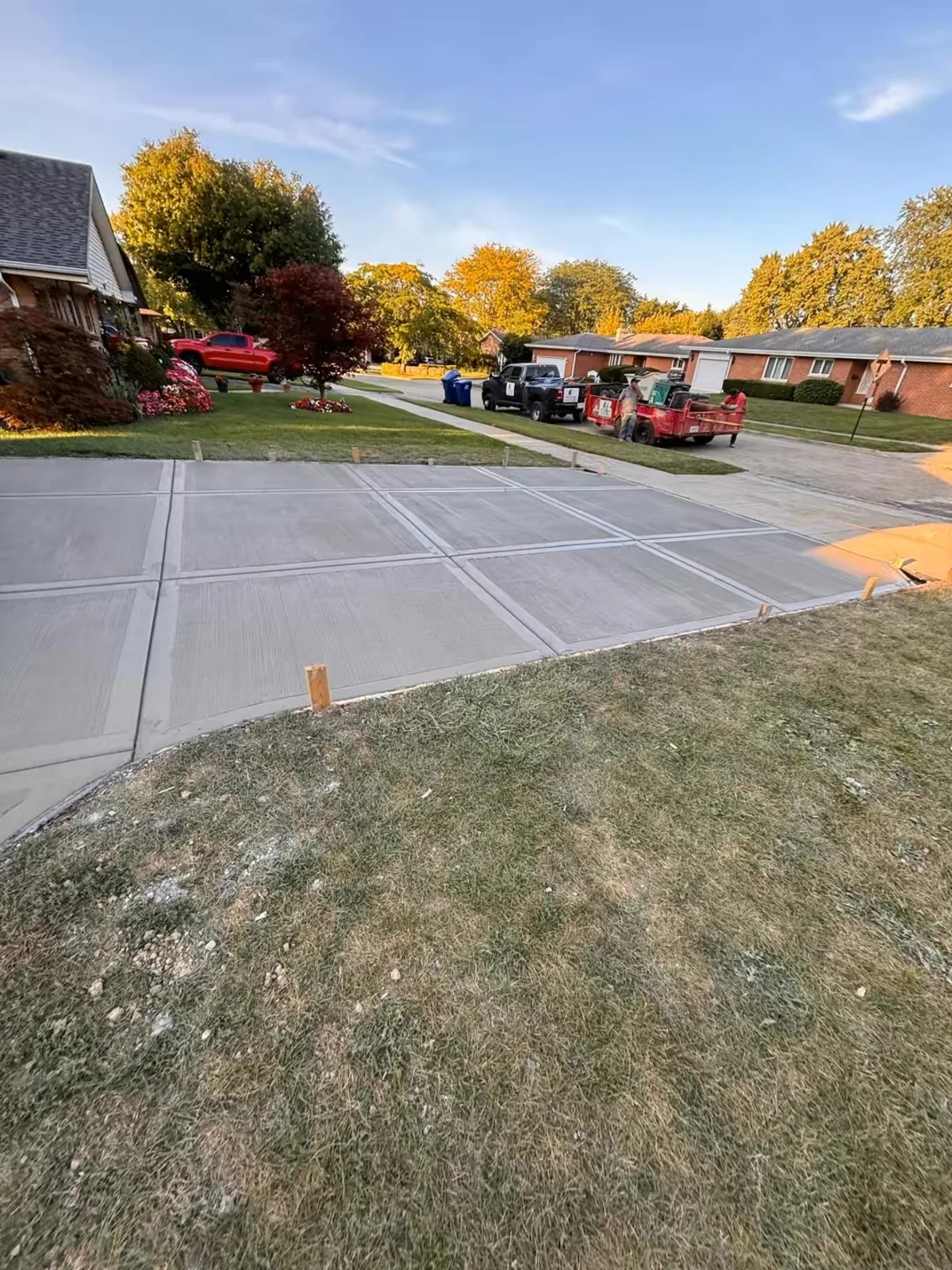
When damage is extensive — widespread cracking, severe heaving, crumbling base — full driveway replacement is the most practical solution. This involves demolishing the existing slab, preparing a proper compacted gravel base, and pouring new reinforced concrete. Cost: $8 to $15 per square foot for a standard broom-finish driveway, or $12 to $25+ for stamped or decorative concrete. A properly installed new driveway with air-entrained concrete and fiber mesh reinforcement lasts 25 to 30+ years.
Repair vs. Replace: Making the Right Decision
Here's a practical framework for deciding:
✓ Repair When:
- • Damage is isolated to one area or section
- • Cracks are narrow (under ½ inch) and limited
- • Surface spalling but the slab is structurally solid
- • Slab is less than 15 years old
- • Repair cost is less than 50% of replacement cost
- • One section has sunk but the rest is level
✗ Replace When:
- • Cracking is widespread throughout the entire slab
- • Significant heaving or settlement (over 1–2 inches)
- • Tree roots have undermined the base
- • Slab is over 25 years old with recurring problems
- • Repair costs approach 50%+ of replacement cost
- • You want to upgrade to stamped or decorative concrete
Concrete Driveway Repair Costs
| Repair Type | Cost Range |
|---|---|
| Crack sealing | $1 – $3 / linear foot |
| Surface patching | $3 – $8 / sq ft |
| Resurfacing overlay | $5 – $15 / sq ft |
| Mudjacking / foam leveling | $500 – $1,500 / section |
| Section replacement | $8 – $12 / sq ft |
| Full driveway replacement | $8 – $15 / sq ft |
For a typical two-car driveway (400–600 sq ft), crack sealing might run $200–$500, resurfacing $2,000–$9,000, and full replacement $3,200–$9,000. These ranges reflect 2026 pricing in the McHenry and Lake County area.
Preventing Future Driveway Damage
Whether you repair or replace, these maintenance practices extend your driveway's life significantly:
- 1.Apply a penetrating concrete sealer every 2–3 years. This reduces water absorption — the primary cause of freeze-thaw damage in our climate.
- 2.Avoid rock salt deicers. Use sand, kitty litter, or calcium magnesium acetate (CMA) for traction. Salt accelerates surface spalling.
- 3.Fix cracks immediately. A $5 tube of concrete caulk today prevents a $500 repair next year.
- 4.Ensure proper drainage. Water should flow away from the slab edges, not pool against them. Adjust grading if needed.
- 5.Remove oil stains promptly. Oil softens concrete over time and accelerates surface deterioration.
- 6.Avoid parking heavy equipment or RVs on residential-grade driveways not designed for those loads.
Get a Professional Driveway Assessment
Not sure whether your driveway needs patching, resurfacing, or replacement? At RCC Masonry & Concrete, we provide free on-site assessments for homeowners throughout McHenry and Lake County. We'll inspect the damage, identify the underlying cause, and recommend the most cost-effective solution — whether that's a simple repair or a new driveway built to last.
Call us at (224) 441-5284 or request your free estimate online. Every concrete project comes with our 5-year workmanship warranty and transparent, no-surprise pricing.