Every spring, Northern Illinois homeowners should conduct a critical inspection: checking their brickwork for winter damage. Our region's brutal freeze-thaw cycles — sometimes 80+ per winter — are the number one enemy of masonry. Water enters tiny cracks, freezes, expands by 9%, and slowly tears brick and mortar apart from the inside out.
At RCC Masonry & Concrete, we repair winter-damaged masonry across McHenry County and Lake County every spring. Here are the warning signs we tell every homeowner to look for — and what to do when you find them.
1. Spalling Bricks: Flaking, Chipping & Crumbling Faces
Spalling is the most visible sign of freeze-thaw damage. You'll notice brick faces flaking off in layers, leaving rough, pitted surfaces behind. This happens when water trapped inside the brick freezes and forces the outer layer to pop off. Spalling is especially common on softer, older bricks and on walls that face prevailing winter winds.
What to do: A few spalled bricks can be individually replaced by a mason who matches the size, color, and texture. If spalling is widespread (more than 15–20% of a wall), the underlying issue — usually failed mortar joints allowing bulk water entry — needs to be addressed through professional tuckpointing before replacing damaged units.
2. Crumbling or Missing Mortar Joints
Run your finger along the mortar joints between your bricks. If mortar crumbles to the touch, falls out in chunks, or is recessed more than ¼ inch behind the brick face, winter has taken its toll. Deteriorated mortar joints are the primary entry point for water, making every other type of damage worse. They're also the easiest and most affordable problem to fix — if caught early.
What to do: Tuckpointing — removing the damaged mortar and replacing it with fresh, properly matched mortar — is the standard repair. In Northern Illinois, this typically costs $8–$15 per square foot and should be completed before the next freeze season begins.
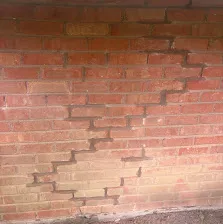
3. Stair-Step & Horizontal Cracks
Cracks that follow the mortar joints in a stair-step pattern indicate differential settlement or lateral pressure — both of which are worsened by winter frost heaving. Horizontal cracks, especially in foundation walls or retaining walls, suggest hydrostatic pressure from frozen, expanding soil pushing against the masonry. Either pattern requires prompt professional evaluation.
What to do: Don't ignore structural cracks. A qualified mason should assess whether the issue is cosmetic (repointing may suffice) or structural (reinforcement, wall ties, or partial reconstruction may be needed). Our team provides free crack assessments throughout our service area.
4. Efflorescence: White Powdery Deposits
Those white, chalky stains on your bricks aren't paint — they're efflorescence, caused by water dissolving salts within the masonry and depositing them on the surface as it evaporates. While efflorescence itself is cosmetic, it's a clear indicator that water is moving through your masonry. After a harsh winter, new efflorescence signals that freeze-thaw cycles have opened pathways for moisture.
What to do: Efflorescence can be cleaned with a mild muriatic acid solution or specialized masonry cleaning. More importantly, find and fix the water entry point — usually failed mortar joints, cracks, or missing cap flashing.
5. Bowing or Bulging Walls
Stand at the corner of your house and sight along the wall. If it bows outward — even slightly — you have a serious structural issue. Bowing happens when corroded wall ties fail, when sustained water infiltration weakens the mortar, or when frost heaving pushes a foundation wall inward. This is the most urgent winter damage finding and requires immediate professional attention.
6. Damaged Chimney Crown & Cap
Your chimney takes the worst winter punishment of any masonry element — it's exposed on all four sides above the roofline, with zero wind protection. Check for cracks in the crown (the cement cap on top), missing or cracked cap flashing, and deteriorated mortar on the chimney stack. Water entering through a failed crown causes rapid internal deterioration that's invisible until bricks start falling off.
What to do: Chimney repair should be a spring priority. Crown resurfacing, reflashing, and tuckpointing the chimney stack are standard repairs that prevent catastrophic chimney failure.
7. Water Stains or Damp Spots on Interior Walls
Don't limit your inspection to the outside. Check interior walls that back up to exterior masonry for water stains, peeling paint, damp plaster, or musty smells. These signs mean water is penetrating through failed masonry and causing hidden damage to framing, insulation, and drywall behind the brick.
Your Spring Inspection Checklist
- ✓ Walk all four sides of your home — examine every brick surface at eye level
- ✓ Use binoculars to check upper stories, gable ends, and chimney
- ✓ Run a finger along mortar joints — note any that crumble or are recessed
- ✓ Sight along walls from corners to detect bowing or bulging
- ✓ Check for white deposits (efflorescence) and note their location
- ✓ Inspect window sills, lintels, and arches for cracks or separation
- ✓ Look at interior walls backing up to exterior masonry for moisture signs
- ✓ Photograph any damage for comparison year-over-year
When to Call a Professional
Minor mortar deterioration on a small area might wait until summer for tuckpointing. But any structural cracking, bowing walls, widespread spalling, or chimney damage should be evaluated immediately. The longer you wait, the more water enters during spring rains — and the more expensive the repair becomes.
RCC Masonry & Concrete offers free spring damage assessments throughout McHenry County and Lake County. With 15+ years of hands-on field experience in Illinois masonry, we'll give you an honest evaluation of what needs immediate attention and what can wait. Call (224) 441-5284 to schedule your inspection.