If you're a business owner or property developer planning a new parking lot or replacing a failing one, understanding the true cost of a commercial concrete parking lot is critical for budgeting and making informed decisions. This guide breaks down every cost factor based on real-world pricing in Northern Illinois.
Concrete parking lots cost more upfront than asphalt, but they last significantly longer — 30 to 40+ years compared to asphalt's 15 to 20 years — and require far less maintenance. For many commercial property owners, concrete is the better long-term investment.
Average Cost Breakdown
Here's what commercial property owners in McHenry and Lake County can expect to pay in 2026:
| Lot Size | Approx. Sq Ft | Cost Range |
|---|---|---|
| Small (10–20 spaces) | 3,000–6,000 | $30,000 – $90,000 |
| Medium (20–50 spaces) | 6,000–15,000 | $60,000 – $225,000 |
| Large (50–100 spaces) | 15,000–30,000 | $150,000 – $450,000 |
| Extra Large (100+ spaces) | 30,000+ | $300,000+ |
These ranges include excavation, sub-base preparation, concrete pouring, finishing, control joints, basic drainage, and standard line striping. ADA features, decorative elements, and complex drainage systems add to these base costs.
Cost Factors Explained
1. Site Preparation and Excavation
Before any concrete is poured, the existing surface must be removed and the ground properly prepared. This includes demolition of existing pavement ($1.50–$3.00/sq ft), excavation to proper depth, soil compaction, and installation of compacted CA-6 crushed stone sub-base (6–12 inches deep). Poor soil conditions — common in the clay-heavy soils of McHenry County — may require deeper excavation, soil remediation, or geotextile fabric underlayment, adding $1–$3 per square foot.
2. Concrete Thickness and Mix Design
Standard commercial parking areas use 5-inch slabs with 4,500 PSI air-entrained concrete. Areas handling truck traffic require 6–8 inches at 5,000+ PSI. The difference between a 5-inch and 6-inch slab is approximately $1.50–$2.50 per square foot — but that extra inch can double the load-bearing capacity and add years of service life. Every exterior pour in our region should use air-entrained concrete to resist the freeze-thaw cycles that destroy non-air-entrained slabs.
3. Steel Reinforcement
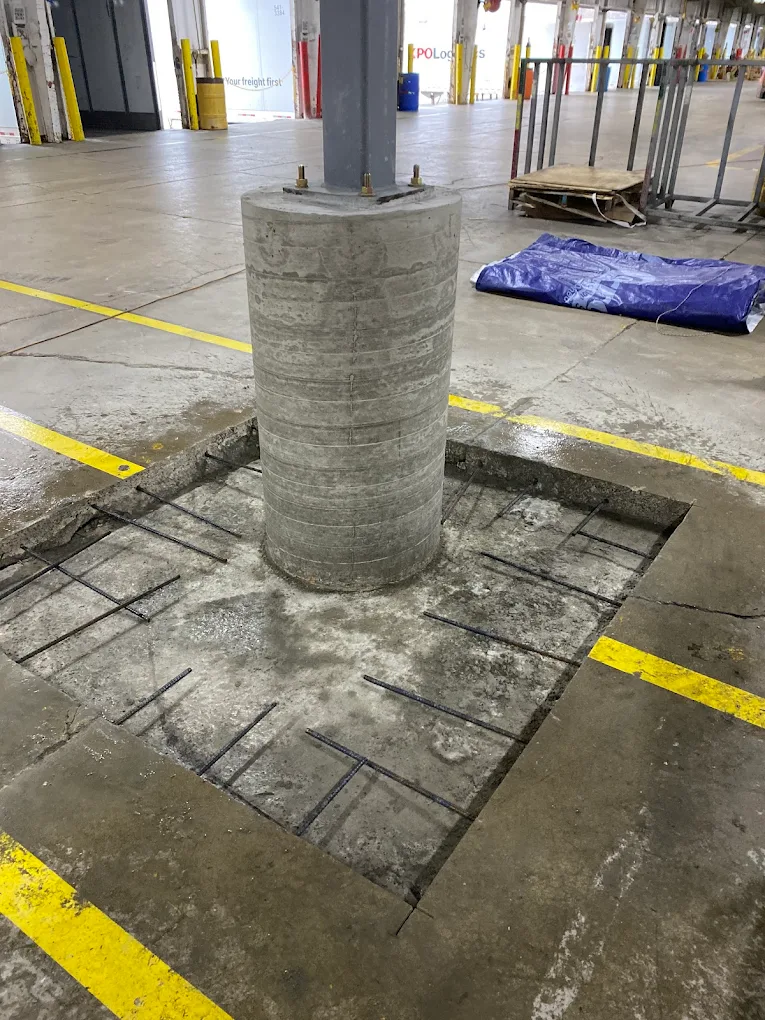
Commercial parking lots require steel rebar reinforcement — not just fiber or wire mesh. Standard parking areas use #4 rebar on 18-inch centers in both directions, placed on chairs to keep the steel centered in the slab. Heavy-duty areas upgrade to #5 rebar on 12-inch centers. Dowel bars at construction joints maintain load transfer across joint lines. Reinforcement adds $1.50–$3.50 per square foot depending on the specification.
4. Drainage Systems
Proper drainage is critical and often the most overlooked cost factor. Every parking lot must manage stormwater runoff per local ordinances. Options range from simple slope-to-drain designs ($1–$2/sq ft) to catch basins with underground piping ($3–$6/sq ft) to retention/detention systems for larger lots ($5–$10/sq ft). McHenry and Lake County municipalities have specific stormwater management requirements that must be met before permits are issued.
5. ADA Compliance Features
ADA requirements are not optional for commercial properties. Required features include accessible parking spaces, van-accessible spaces, curb ramps with detectable warning surfaces, accessible routes to building entrances, and proper signage. Budget $2,000–$5,000 per accessible space for the full installation including curb ramps, signage, and striping. Non-compliance exposes property owners to lawsuits and Department of Justice enforcement actions.
6. Striping and Signage
Line striping typically costs $0.25–$0.50 per linear foot for standard parking lines, plus $75–$200 per accessible space for the required blue paint, access aisles, and wheelchair symbols. Directional arrows, fire lane markings, "No Parking" zones, and speed bumps are additional items that add $500–$2,000 depending on lot complexity.
Concrete vs Asphalt: Long-Term Cost Analysis
Many property owners default to asphalt because the upfront price is lower. But here's how the numbers play out over 30 years for a 10,000 square foot parking lot:
| Cost Category | Asphalt | Concrete |
|---|---|---|
| Initial installation | $50,000 | $120,000 |
| Seal coating (every 2-3 yrs) | $22,500 | $0 |
| Crack repair & patching | $15,000 | $3,000 |
| Full replacement (year 18) | $55,000 | $0 |
| 30-Year Total | $142,500 | $123,000 |
| Savings | — | $19,500 less |
Concrete wins on lifetime value in nearly every scenario. The larger the lot and the longer the ownership horizon, the more compelling the concrete advantage becomes.
How to Reduce Parking Lot Costs
- Phase the project — pour in sections to spread costs across budget cycles
- Schedule during off-peak months (early summer or late fall) for better contractor availability and pricing
- Combine with other concrete work (sidewalks, loading docks) for volume discounts on material and mobilization
- Design with long-term maintenance in mind — proper joint spacing and drainage reduce future repair costs
- Get multiple bids, but compare specifications carefully — the cheapest bid often cuts corners on thickness or reinforcement
Get Your Free Commercial Estimate
At RCC Masonry & Concrete, we provide detailed commercial parking lot estimates that break down every cost — no surprises, no hidden fees. We serve commercial properties throughout McHenry and Lake County, IL, and our team handles everything from site engineering and permitting to pouring, finishing, and striping.
Call (224) 441-5284 or request your free estimate online. Licensed, bonded, and insured — with a 5-year warranty on all commercial concrete work.