After 20 years of Illinois winters, a Grayslake homeowner's concrete driveway was in rough shape: widespread spalling, multiple heaved sections creating trip hazards, and cracks that had been patched so many times the surface looked like a patchwork quilt. Repair was no longer practical — it was time for a complete replacement.
Assessment: Why Repair Wasn't an Option
When RCC Masonry & Concrete inspected the driveway, we found that over 40% of the surface was damaged. Three sections had heaved 1–2 inches due to sub-base failure, creating trip hazards. The original concrete was only 3.5 inches thick (below the 4-inch minimum for driveways) and showed no evidence of air-entrained mix — a critical requirement for freeze-thaw resistance in Illinois.
Project Overview
Day 1: Demolition
Our crew used a skid-steer with a hydraulic breaker to demolish the existing driveway, then loaded the broken concrete into dump trailers for disposal. We also removed the deteriorated apron where the driveway meets the public sidewalk. Total material removed: approximately 18 tons.
Day 2: Grading & Sub-Base
With the old concrete removed, we addressed the root cause of the heaving: the sub-base was a mix of clay soil and random fill with poor compaction. We excavated an additional 4 inches, installed woven geotextile fabric to prevent soil migration, and placed 4 inches of CA-6 crushed limestone sub-base, compacted in 2-inch lifts with a plate compactor. Proper drainage slope was established — ⅛ inch per foot toward the street.
Day 3: Forming & Pouring
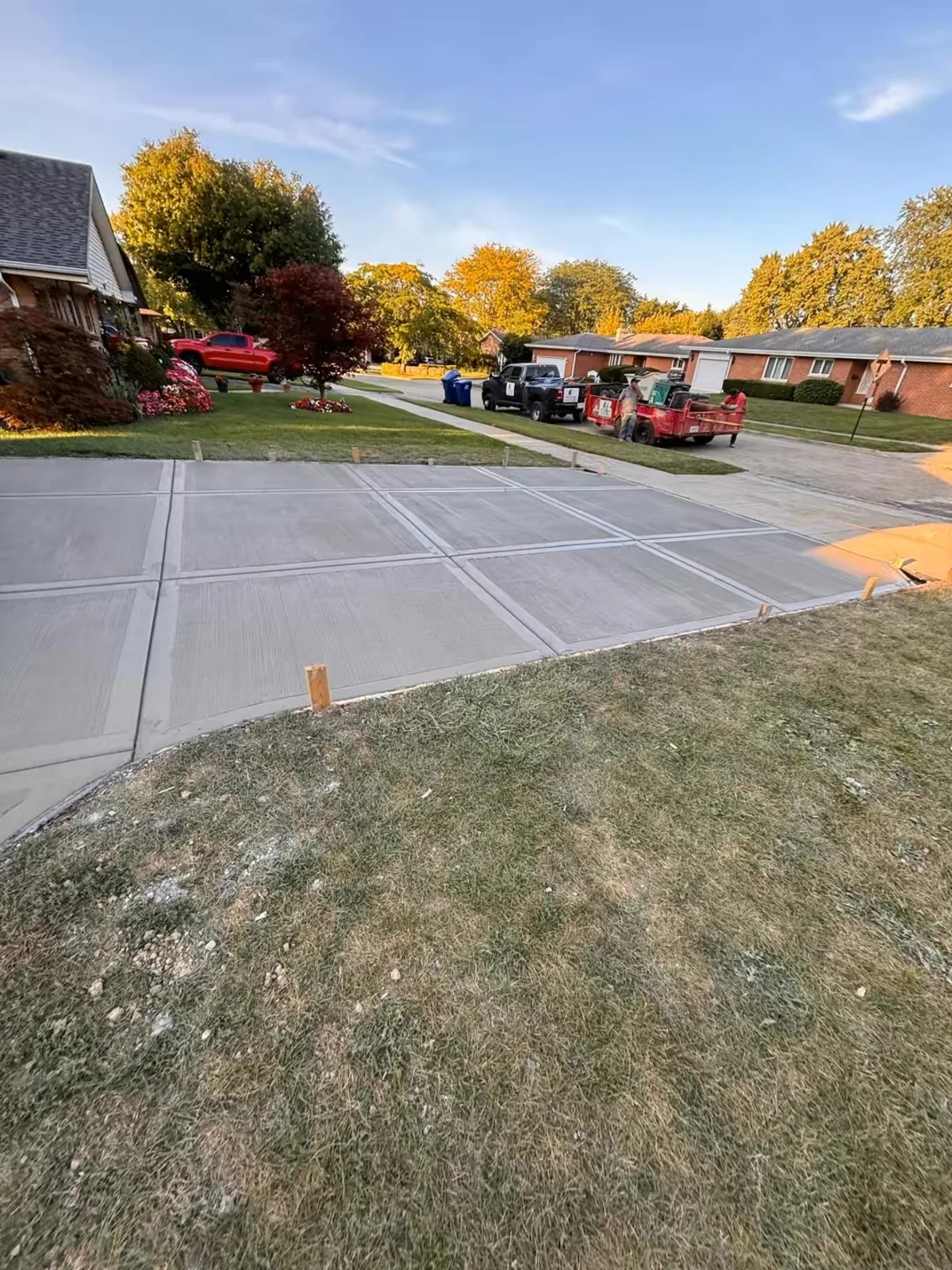
We set dimensional lumber forms to establish the driveway edges and control joint locations (every 10 feet for a driveway this width). The concrete spec: 4,000 PSI air-entrained mix with 6% air content — essential for freeze-thaw durability. Fiber mesh reinforcement was specified instead of wire mesh for better crack control. We also installed isolation joints where the new driveway meets the garage floor and sidewalk.
Day 4: Finishing & Curing
The surface was bull-floated, then finished with a medium broom texture for optimal traction. Control joints were cut within 12 hours of the pour to control where the concrete cracks (every properly poured driveway cracks — control joints ensure it cracks in straight, invisible lines). Curing compound was applied immediately to retain moisture for proper hydration.
Day 5: Cleanup & Owner Orientation
Forms were stripped, edges were backfilled with topsoil, and the job site was cleaned. We walked the homeowner through curing requirements (no vehicles for 7 days, no salt for the first winter), maintenance recommendations, and handed over their 5-year warranty documentation.
The Result
The homeowner now has a properly engineered driveway built to handle Northern Illinois conditions. The 4-inch thick, air-entrained concrete with proper sub-base preparation will resist heaving, spalling, and cracking for 25–30 years. The integral sandstone color adds curb appeal without the maintenance requirements of stamped concrete.
Ready for a new concrete driveway? RCC Masonry & Concrete provides free estimates throughout McHenry County and Lake County. Call (224) 441-5284 to get started.