A two-story commercial building in McHenry, IL was losing tenants. The reason: persistent water infiltration through deteriorated brick mortar joints was causing interior wall damage, mold growth, and ceiling staining in multiple tenant spaces. The building owner had patched individual areas for years, but the underlying problem — widespread mortar failure — needed a comprehensive solution.
The Problem: Decades of Patchwork Repairs
RCC Masonry & Concrete's inspection revealed that approximately 70% of the mortar joints on the building's west and north facades had deteriorated to the point of failure. These walls faced the prevailing winter weather, absorbing the worst of Illinois' wind-driven rain and freeze-thaw cycles. Previous spot repairs used mismatched mortar colors and inconsistent joint profiles, creating an unsightly patchwork that also wasn't holding up.
We also identified failed caulk joints around 22 windows, cracked lintels above two first-floor windows, and a parapet cap that was channeling water directly into the wall cavity.
Project Overview
Our Solution: Comprehensive Envelope Repair
Rather than more patchwork, we proposed a complete building envelope approach: full tuckpointing of the weather-exposed facades, targeted tuckpointing on the sheltered sides, window caulk replacement, lintel repair, and parapet cap restoration. This holistic approach addresses all water entry points simultaneously, ensuring the building is sealed as a system.
Phase 1: Scaffolding & Joint Preparation
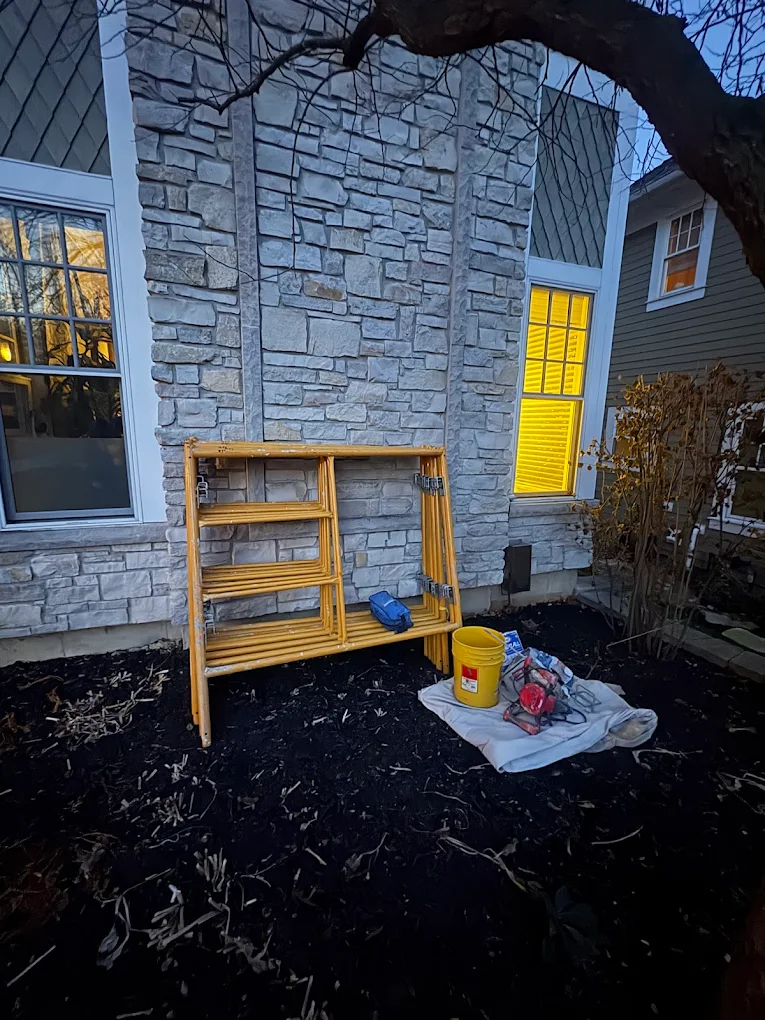
Scaffolding was erected on the west and north facades (the most deteriorated sides). Using diamond-blade grinders, our masons removed deteriorated mortar to a minimum depth of ¾ inch — deep enough to ensure the new mortar has adequate bonding surface. Previous patch repairs in hard Portland cement mortar were completely removed to create uniform joint conditions.
Phase 2: Repointing & Brick Replacement
Repointing was done with a custom-colored Type N mortar matching the building's original warm gray tone. We replaced 28 spalled bricks with color-matched units. All joints were tooled to a consistent concave profile — both for aesthetics and for optimal water shedding. The concave profile creates a dense, compressed surface that resists water penetration far better than a flat or raked joint.
Phase 3: Windows, Lintels & Parapet
All 22 window perimeters were recaulked with high-performance polyurethane sealant rated for masonry. Two cracked steel lintels were reinforced with steel angle supports. The parapet cap was rebuilt with proper slope to drain water outward rather than into the wall cavity.
The Result
Six months after completion, the building owner reported zero water infiltration incidents — down from monthly complaints. Two previously vacant tenant spaces were re-leased, more than recovering the project investment. The building's appearance was dramatically improved, with consistent mortar color replacing the previous patchwork of mismatched repairs.
Own a commercial building with masonry problems? RCC Masonry & Concrete specializes in commercial tuckpointing and building envelope repair throughout McHenry County and Lake County. Call (224) 441-5284 for a free building assessment.